


Measurement-based care (MBC) describes the evidence-based practice of using systematic and routine assessment of the patient’s perspective through patient-reported progress and outcomes, such as symptoms and functioning, throughout the course of mental and behavioral care, to inform treatment decisions and engage patients in their treatment (Scott & Lewis, 2015).
MBC promotes data-informed, patient-centered care.
Key components
MBC is a clinical process consisting of three essential components:
- Routinely collecting patient-reported outcomes throughout the course of treatment
- Sharing timely feedback with the patient about their reported progress scores and trends over time
- Acting on these data in the context of the provider’s clinical judgment and the patient’s experiences to guide the course of care (i.e., shared-decision making regarding treatment; Lewis et al., 2018; Oslin et al., 2019; Resnick & Hoff, 2019)
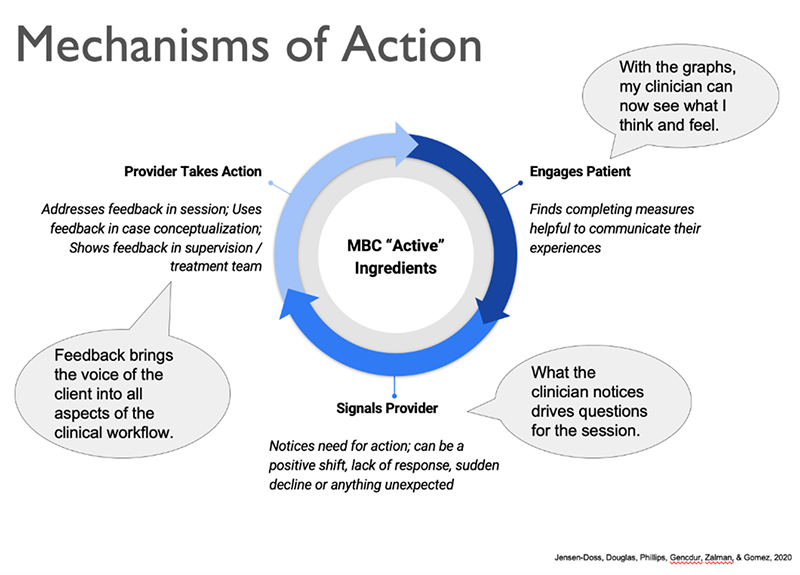
MBC shares overlapping characteristics with related organizational practices such as routine outcomes monitoring and program evaluation, though is understood to be conceptually distinct from these applications as the data collected in MBC are specifically intended to make dynamic changes during treatment at the individual level (Lewis et al., 2018).
However, organizations can use aggregated MBC data to support organizational goals such as quality improvement efforts and satisfying accreditation or other accountability standards (Connors et al., 2021; Jensen-Doss et al., 2020).
Measurement-based care is a core element of evidence-based practice
Evidence-based practice is the integration of the best available research with clinical expertise in the context of patient characteristics, culture, and preferences (APA Presidential Task Force on Evidence-Based Practice, 2006).
What this means is that clinical decision making should occur in partnership with the patient, informed by the best research evidence, taking into consideration the available options and the patient’s individual circumstances and preferences. Treatment planning, in this manner, should be ongoing, updating and adjusting care as needed through regular monitoring of patient progress.
The key elements of MBC including measuring progress, using that information to adjust care, and sharing that information with patients make MBC a core element of evidence-based practice.
Benefits of MBC for psychologists and patients
Evidence base for MBC
Since research into MBC began in 2001 (Lambert et al., 2001), a number of reviews and meta-analyses have been conducted to investigate its effects.
- Researchers analyzed 51 randomized controlled trials exploring how frequently providers collected feedback on patient-reported symptoms during medication management and psychotherapy encounters and found that almost all the trials that consistently used MBC showed significantly improved patient outcomes, while one-time screenings and assessing symptoms infrequently were less effective (Fortney, J. C., et al., 2017).
- A narrative review of several meta-analyses and qualitative studies found that not only did measurement-based care outperform usual care; it was also associated with decreased costs and a lower likelihood of patient deterioration while in treatment (Lewis, C. C., et al., 2019).
- De Jong and colleagues (2021) utilized a multilevel meta-analysis analyzing 110 effect sizes in 21,699 patients and reported a small effect on symptom reduction across all case types (d=0.15), as well as a small, favorable effect on dropout rates (OR=1.19). Greater effects were seen in subpopulations of cases identified as “not on track.”
- In the absence of MBC, research demonstrates that clinicians struggle to identify the patients who are at a higher risk for nonresponse, or even deterioration in functioning (Constantino et al., 2019; Walfish et al., 2012).
Numerous studies looking at the impact of MBC have found
- Improved symptom and functioning outcomes (de Jong et al., 2021; Goodman et al., 2013; Reese et al., 2009, 2010)
- Lower rates of separation/divorce in couples therapy (Anker et al., 2009)
- Reduced rates of nonresponse and lower dropout rates (de Jong et al., 2021)
The benefits of MBC to psychologists and patients extend beyond symptom outcomes and retention
- MBC is associated with increased feedback to patients regarding progress (Bobbitt et al., 2012; Lambert, 2010) and improved customer/patient satisfaction (Johnson & Shaha, 1996; Knaup et al., 2009; DeSaeger et al., 2014).
- Patients in treatments that integrate MBC report experiencing a higher level of engagement in their treatment, as well as a higher level of respect from treatment providers because it communicates that their perspective is highly valued (Dowrick et al., 2009; Eisen et al., 2000; Moltu et al., 2018).
- MBC enhances clinical responsiveness to the individual patient (Boswell et al., 2015; Brooks Holliday et al., 2020; Constantino et al., 2013), for example, by adjusting the treatment plan or revisiting expectations and goals.
- MBC is associated with increases in patient-reported working alliance quality, relative to as-usual treatments that do not include MBC (Brattland et al., 2019).
References
American Psychological Association, Presidential Task Force on Evidence-Based Practice. (2006). Evidence-based practice in psychology. American Psychologist, 61(4), 271–285. https://doi.org/10.1037/0003-066X.61.4.271opens in new window
Boswell, J. F., Kraus, D. R., Castonguay, L. G., & Youn, S. J. (2015). Treatment outcome package: Measuring and facilitating multidimensional change. Psychotherapy, 52(4), 422–431. https://doi.org/10.1037/pst0000028opens in new window
Brattland, H., Koksvik, J. M., Burkeland, O., Klöckner, C. A., Lara-Cabrera, M. L., Miller, S. D., Wampold, B., Ryum, T., & Iversen, V. C. (2019). Does the working alliance mediate the effect of routine outcome monitoring (ROM) and alliance feedback on psychotherapy outcomes? A secondary analysis from a randomized clinical trial. Journal of Counseling Psychology, 66(2), 234–246. https://doi.org/10.1037/cou0000320opens in new window
Brooks Holliday, S., Hepner, K. A., Farmer, C. M., Mahmud, A., Kimerling, R., Smith, B. N., & Rosen, C. (2020). Discussing measurement-based care with patients: An analysis of clinician-patient dyads. Psychotherapy Research. Advance online publication. https://doi.org/10.1080/10503307.2020.1776413opens in new window
Constantino, M. J., Boswell, J. F., Bernecker, S. L., & Castonguay, L. G. (2013). Context-responsive integration as a framework for unified psychotherapy and clinical science: Conceptual and empirical considerations. Journal of Unified Psychotherapy and Clinical Science, 2, 1–20.
de Jong, K., Conijn, J. M., Gallagher, R. A. V., Reshetnikova, A. S., Heij, M., & Lutz, M. C. (2021). Using progress feedback to improve outcomes and reduce drop-out, treatment duration, and deterioration: A multilevel meta-analysis. Clinical Psychology Review, 85, Article 102002. https://doi.org/10.1016/j.cpr.2021.102002opens in new window
Dowrick, C., Leydon, G. M, McBride, A., Howe, A., Burgess, H., Clarke, P., Maisey, S., & Kendrick, T. (2009). Patients’ and doctors’ views on depression severity questionnaires incentivised in UK quality and outcomes framework: Qualitative study. BMJ: British Medical Journal, 338(7697), 1–9. https://doi.org/10.1136/bmj.b663opens in new window
Eisen, S. V., Dickey, B., & Sederer, L. I. (2000). A self-report symptom and problem rating scale to increase inpatients' involvement in treatment. Psychiatric Services, 51(3), 349–353. https://doi.org/10.1176/appi.ps.51.3.349opens in new window
Fortney, J. C., Unützer, J., Wrenn, G., Pyne, J. M., Smith, G. R., Schoenbaum, M., & Harbin, H. T. (2017). A tipping point for measurement-based care. Psychiatric Services, 68(2), 179–188. https://doi.org/10.1176/appi.ps.201500439opens in new window
Jensen-Doss, A., Douglas, S., Phillips, D. A., Gencdur, O., Zalman, A., & Gomez, N. E. (2020). Measurement-based care as a practice improvement tool: Clinical and organizational applications in youth mental health. Evidence-Based Practice in Child and Adolescent Mental Health, 5(3), 233–250. https://doi.org/10.1080/23794925.2020.1784062opens in new window
Knaup, C., Koesters, M., Schoefer, D., Becker, T., & Puschner, B. (2009). Effect of feedback of treatment outcome in specialist mental healthcare: Meta-analysis. The British Journal of Psychiatry, 195(1), 15–22. https://doi.org/10.1192/bjp.bp.108.053967opens in new window
Lambert, M. J., Hansen, N. B., & Finch, A. E. (2001). Patient-focused research: Using patient outcome data to enhance treatment effects. Journal of Consulting and Clinical Psychology, 69(2), 159–172. https://doi.org/10.1037/0022-006X.69.2.159opens in new window
Lambert, M. J. (2010). Prevention of treatment failure: The use of measuring, monitoring, and feedback in clinical practice. American Psychological Association. https://doi.org/10.1037/12141-000opens in new window
Lewis, C. C., Mettert, K. D., Dorsey, C. N., Martinez, R. G., Weiner, B. J., Nolen, E., Stanick, C., Halko, H., & Powell, B. J. (2018). An updated protocol for a systematic review of implementation-related measures. Systematic Reviews, 7, 66. https://doi.org/10.1186/s13643-018-0728-3
Lewis, C. C., Boyd, M., Puspitasari, A., Navarro, E., Howard, J., Kassab, H., Hoffman, M., Scott, K., Lyon, A., Douglas, S., Simon, G., & Kroenke, K. (2019). Implementing measurement-based care in behavioral health: A review. JAMA Psychiatry, 76(3), 324–335. https://doi.org/10.1001/jamapsychiatry.2018.3329opens in new window
Moltu, C., Veseth, M., Stefansen, J., Nøtnes, J. C., Skjølberg, Å., Binder, P.-E., Castonguay, L. G., & Nordberg, S. S. (2018). This is what I need a clinical feedback system to do for me: A qualitative inquiry into therapists’ and patients’ perspectives. Psychotherapy Research, 28(2), 250–263. https://doi.org/10.1080/10503307.2016.1189619opens in new window
Oslin, D. W., Hoff, R., Mignogna, J., & Resnick, S. G. (2019). Provider attitudes and experience with measurement-based mental health care in the VA implementation project. Psychiatric Services, 70(2), 135–138. https://doi.org/10.1176/appi.ps.201800228opens in new window
Resnick, S. G., & Hoff, R. A. (2020). Observations from the national implementation of Measurement Based Care in Mental Health in the Department of Veterans Affairs.Psychological Services, 17(3), 238–246. https://doi.org/10.1037/ser0000351opens in new window
Scott, K., & Lewis, C. C. (2015). Using measurement-based care to enhance any treatment. Cognitive and Behavioral Practice, 22(1), 49–59. https://doi.org/10.1016/j.cbpra.2014.01.010opens in new window
Walfish, S., McAlister, B., O’Donnell, P., & Lambert, M. J. (2012). An investigation of self-assessment bias in mental health providers. Psychological Reports, 110(2), 639–644. https://doi.org/10.2466/02.07.17.PR0.110.2.639-644opens in new window