



skip to main content

Anxiety Matters with Dr. Bonnie Zucker and Dr. Bonnie Zucker

When two psychologists with the same name and specialty linked up, a podcast was born
APA Style leaf logo Cite This Article in APA Style
Medaris, A. (2025, May 13). Anxiety matters with Dr. Bonnie Zucker and Dr. Bonnie Zucker. https://www.apaservices.org/practice/news/anxiety-tools

Bonnie Zucker, PhD, and Bonnie Zucker, PsyD

One of the first emotions Bonnie Zucker, PhD, felt when coming across Bonnie Zucker, PsyD, was irritation bordering on anger. 

The former Zucker, a clinical psychologist in Los Angeles who specializes in anxiety, was building her private practice and eager to secure a domain name for her website. But not only was BonnieZucker.comopens in new window already taken—it was taken by another clinical psychologist who lived near Washington, D.C., and also specialized in anxiety. 

“I had people over for dinner that night and said to them, ‘Look at this! She has my website!’” The LA-based Zucker remembered. “It was annoying, to be honest.” 
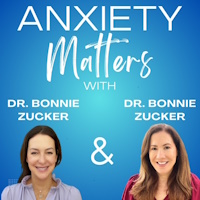
Photo of podcast Since then, though, the Zuckers’ feelings toward each other have grown into a sort of sisterly love. In fact, they are so fond of each other personally and professionally that they recently launched a podcast called Anxiety Matters with Dr. Bonnie Zucker and Dr. Bonnie Zuckeropens in new window. The weekly show—geared toward a general audience, but also of interest to fellow clinicians—features guest interviews with mental health experts and thought leaders, reveals their personal experiences as moms and psychologists, and addresses a range of anxiety-related topics, from tech to parenting. 

The West Coast Zucker said they quickly realized that “if the focus is on anxiety, it touches on everything.” We talked to the bi-coastal duo, who refer to each other as “Bonnie East” and “Bonnie West,” about their relationship, expertise, and what else they hope their podcast will accomplish.

The meet-cute

Around the same time as the website incident, the D.C.-based Zucker sent her counterpart a LinkedIn message. She’d noticed her name doppelgänger over the years on the Association for Behavioral and Cognitive Therapies’ listserv. “Hi, West Coast twin!” she wrote. (By then, that twin had settled for the BonnieZuckerPhd.comopens in new window URL).

The two struck up a casual correspondence, but didn’t meet in real life until 2022, when the East Coast Zucker was vacationing with her family in LA. It was friendship at first sight: The women were wearing the exact same sandals and polish, they were about the same age, and had both met their husbands in breweries. The list of similarities goes on. 

“We were screaming, hugging, and my kids were like, ‘What is going on with these people?’” the vacationing Zucker recalled. “It was just hysterical.” 

After two more meetups and a few calls, the pair decided to launch a podcast. In addition to helping build their platforms (both are writers too), the show allows the Zuckers to “spend time together and educate the public about psychology,” they said.

Shedding light on underused CBT tools

The East Coast Zucker, who works with all ages and is author of Anxiety-Free Kids: An Interactive Guide for Parents and Childrenopens in new window, is eager for the podcast to bring awareness to overlooked cognitive behavioral therapy strategies. Her top pick is the ladder—an actual drawing of a ladder on which kids with anxiety write out situations that are slightly anxiety provoking (bottom of the ladder) to debilitatingly anxiety provoking (top of the ladder). As children conquer one, they can give themselves a gold star before tackling the next. 

“Writing it down in the ladder form not only helps you measure the progress, but it holds the child and the parents accountable,” said Zucker. That’s important because parents often unintentionally collude with their kids’ disorders by, for example, accompanying a child with separation anxiety at school instead of allowing them to learn that their worst fears are unfounded. 

“Parents often have trouble tolerating their own discomfort, and there’s no way you're going to ask your kid to do it when you're not willing to tolerate it for them,” Zucker said. “It's a parallel process in some ways.”

Another one of her go-to tools is exposure therapy. When patients have social anxiety, Zucker might have them call a bookstore to request a book while in her office. The West Coast Zucker also uses a different form of exposure therapy in patients with panic attacks, who often excessively monitor symptoms like their heart rate or breathing. After educating them on why their fixation works against them, she might have them jog in place to induce the very sensations they fear. 

“It’s almost like you're proving yourself wrong,” said Zucker, who works with teens and adults and whose forthcoming book on panic attacks, Freedom From Panic, is under contract. “That’s why I think exposures can actually be more powerful in many ways than the cognitive element [of CBT].” 

The LA-based Zucker is also passionate about prevention. If, for instance, someone learns early on that everyone has disturbing thoughts sometimes, they may be less likely to develop severe OCD. “Hopefully this podcast will inspire some prevention efforts for people who don’t actually have a disorder, but they might realize, ‘Oh, this compulsion I'm doing might not be serving me in the best way,’” she said. 

As of early April, the Zuckers had launched eight episodes, including an opener on how they met, one on coping with catastrophes after the LA psychologist lived through the fires, and a more light-hearted episode on pets and mental health. The pair said their producer is pleased with how many listeners they’ve attracted and that some of their patients have told them the show helps reinforce what they’re learning in therapy. Best of all, they added, they’re having fun. They may even record a show about the science of identity and names. 

“Let’s not talk about that now—we’ll talk about that on an episode,” the West Coast Zucker said. “OK, perfect,” her Eastern twin chimed in. “I guess you’ll have to listen now too.”