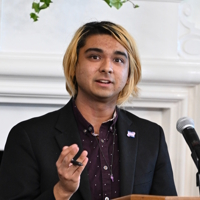
Advocacy is relational – a lot of the work is showing up and building relationships with people to lay the foundations for change efforts.


M Pease, MSc, is a PhD candidate in counseling psychology at the University of Maryland, College Park and doctoral intern at the Towson University Counseling Center
Advocacy is relational – a lot of the work is showing up and building relationships with people to lay the foundations for change efforts.
Advocacy is relational–a lot of the work is showing up and building relationships with people to lay the foundations for change efforts. Being aware of how you show up in these relationships and how your social identities and professional background may help or hinder authentic connection in advocacy spaces is invaluable to doing this work effectively. Borrowing from the work of bell hooks, I try to approach this work from a love ethic. Yes, we are working toward specific policy goals, but the human element–how we treat each other, how we empower one another to sustainably engage with one another in community–matters so much more than any single policy issue. Approaching this work with compassion, cultural humility, and an attunement to power goes a long way.
There are so many forces discouraging psychologists–particularly those from marginalized communities–from safely engaging in advocacy (e.g., general hostile sociopolitical climate, tremendous demands on our time and resources, institutions discouraging visible political engagement, historical lack of focus on advocacy in the field) that many psychologists do not know where to start. We need to build pipelines, programs, mentorship networks, and general community spaces for people to build a sense of competence, connection, and safety in advocacy work for people at all career stages.
My advocacy work is centrally about creating conditions to allow marginalized communities to thrive. For example, using community-based research with trans communities in Maryland to create policy-oriented research reportsopens in new window allowed us to both communicate important advocacy needs to the community and provide something for people to cite when crafting legislative testimony on pressing policy issues facing trans communities. The partnerships we were able to build with community partners allowed us to more effectively get the results from our research into the hands of policymakers and community leaders, helping accelerate the use of the data beyond the academy and into policymaking spaces that could help transform some of the structural barriers to equal access and thriving facing our local community.
It is important to recognize that the issues facing our communities are intersectional–that is, systems of oppression interact to create disparities for people at the intersection of different dimensions of marginalization. While my aforementioned work focused on trans communities, the policy recommendations we generated were not only specific to trans communities, but recognized that racism, classism, xenophobia, ableism, and all forms of oppression interact with one another and that, to truly address issues facing trans communities, we needed to think creatively on the larger forms of injustice that create inequitable conditions. For instance, we engaged in advocacy not only on gender affirming medical care, but also general healthcare access, as well as housing issues, disability justice, criminal justice reform, because all of these issues also touched members of our communities at different intersections of marginalization. We cannot ignore that it is all connected.
M Pease, MSc is a PhD candidate in counseling psychology at the University of Maryland, College Park and doctoral intern at the Towson University Counseling Center. They serve on the American Psychological Association Advocacy Coordinating Committee and are the chair of the Maryland Commission on LGBTQIA+ Affairs, the first out nonbinary person of color to lead an appointed commission in Maryland. Their research program, clinical work, and advocacy efforts broadly center around gender, race and sexuality, exploring how intersectional systems and experiences of oppression contribute to mental health disparities as well as ways to elevate experiences of strength, empowerment, healing, and joy in marginalized communities. They also research how training programs and the profession of psychology at-large can work to empower psychologists to engage in systems advocacy efforts to improve conditions across communities. Their own advocacy work, informed by psychological science, at the local, state, and federal levels has spanned a variety of topic areas, including civil rights, healthcare, science, workplace well-being, and more.
Home State: Maryland
APA Division membership:
SPTA Membership:
Join our Psychology Advocacy Network to get the latest news and action alerts from APA Services.
The Advocate Spotlight highlights individuals and organizations whose advocacy makes a difference by advancing important policy issues that impact psychology on Capitol Hill, in federal agencies, in state capitols, and in your communities.