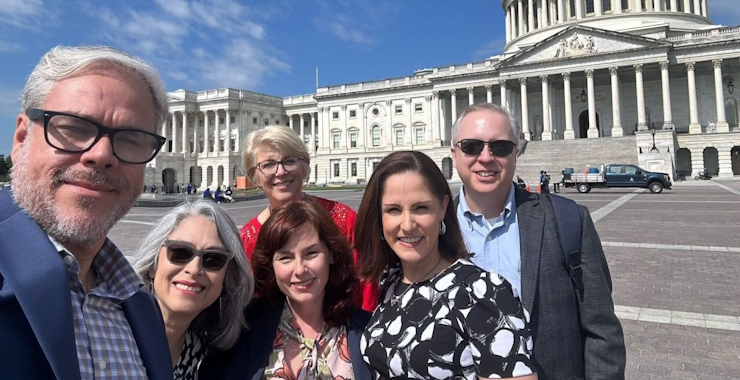
On June 11, 2024, 70 member psychologists led over 170 meetings on Capitol Hill to advocate for policies to strengthen access to Medicare mental and behavioral health services, including telehealth services and services furnished via integrated care models. These participants represented 40 states and included APA Services’ federal advocacy coordinators (FACs) and federal education advocacy coordinators, APA past presidents, members of the APA Board of Directors, and members of the APA Services Advocacy Coordinating Committee. In their meetings, they urged their members of Congress to cosponsor three pieces of legislation:
- the Telemental Health Care Access Act (H.R. 3432/S. 3651)(PDF, 59KB)opens in new window, which would repeal a Medicare requirement that patients must be seen in-person for continued coverage of their telehealth services;
- the Increasing Mental Health Options (IMHO) Act (H.R. 8458/S.669)(PDF, 928KB)opens in new window, which would increase Medicare beneficiaries’ access to mental health care by removing outdated Medicare requirements for physician oversight and referral for services provided by psychologists; and
- the COMPLETE Care Act (H.R. 5819/S. 1378)(PDF, 65KB)opens in new window, which would increase access to mental and behavioral health services by adopting a “model-neutral” approach to assisting practitioners with adoption of integrated care.
To prepare for their Hill meetings, participants gathered on June 10 for an in-person briefing during which they learned about these bills and how they would increase access to mental and behavioral health care services. APA President Cynthia de las Fuentes, PhD, gave welcoming remarks, which were followed by a presentation from APA Chief Advocacy Officer Katherine B. McGuire, MSc, on the shifting political landscape and how to effectively advocate during an election year.
Panel Discussions
Molly Gabriel-Champine, PhD, and Grace Banfield
The second panel featured legislative insights from congressional staff. Grace Banfield, legislative director for Representative Dan Kildee (D-Michigan) and Megan Porter, legislative assistant for Representative Troy Balderson (R-Ohio) each conveyed their perspectives, as congressional staff members, as to how meetings with legislative staff should be conducted in terms of preparation, content, and structure. Banfield and Porter then took questions from the audience.
The third panel of the day focused on state legislative perspectives on telehealth. Deborah Baker, JD, APA’s director, legal and regulatory policy, relayed to participants the current array of state telehealth policies, and ways in which some state legislatures are leading the charge on telehealth policy. Amy Beck, PhD, who serves as the FAC for the Missouri Psychological Association, then spoke about her experiences advocating for audio-only telehealth protections in Missouri.
Advocacy Training
In preparation for their meetings, participants were trained on the three legislative issues. APA Senior Legislative and Regulatory Counsel Andrew Strickland, JD, led the briefing on the Telemental Healthcare Access Act. This bill would repeal a Medicare requirement that patients must be seen in-person for continued coverage of their telehealth services and permanently allow Medicare beneficiaries to receive behavioral health services via telehealth from their own homes.
APA President-elect, Debra Kawahara, PhD, and Katy Trotta, PsyD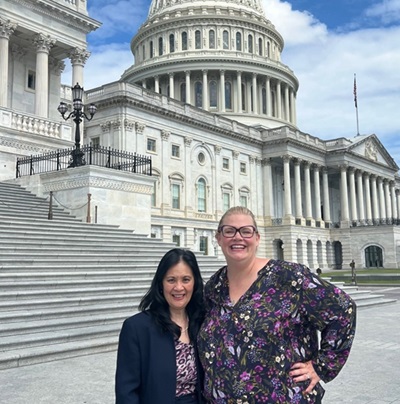
Following the issue briefings, APA’s Deputy Chief of Public Policy and Engagement Stefanie Reeves, FASAE, CAE, led a presentation on how summit attendees can communicate effectively with members of Congress, including how to build rapport, develop and deliver a pitch, follow up with congressional offices after their meetings, and utilize social media to boost their message.
Awards
Throughout the day, awards were presented to congressional staff and members of Congress for their dedication to promoting mental health through their work.
From left to right: Megan Porter, APA Chief Advocacy Officer Katherine B. McGuire, MSc, Grace Banfield
Following the advocacy training, McGuire presented the Congressional Champion Award to two members of Congress who have prominently championed the goals of the discipline and profession of psychology. Representative Michelle Steel (R-California) and Representative Kildee were awarded for their work to increase access to behavioral health services through their sponsorship of the COMPLETE Care Act.