



skip to main content
Research funding

Advocating on Capitol Hill for continued National Institutes of Health investment

At the 2026 Rally for Medical Research Hill Day, psychology advocates urged Congress to sustain NIH investment in mental health research, scientific training, and lifesaving discoveries

APA Style leaf logo Cite This Article in APA Style
American Psychological Association. (2026, October 8). Advocating on Capitol Hill for continued National Institutes of Health investment. https://www.apaservices.org/advocacy/news/capitol-hill-nih-investment

Researchers use microscopes and laboratory equipment while conducting scientific research in a laboratory.

APA Services sponsored the 2026 Rally for Medical Research Hill Day, where APA Board of Scientific Affairs members Brendan Lam and Brian Bauer joined 300 advocates from 40 states in urging Congress to provide robust annual increases (at least $51.3 billion for the NIH base budget in FY 2027) for the National Institutes of Health (NIH). Participants thanked Congress for prioritizing medical research and raised concerns about proposed Office of Management and Budget grantmaking changesopens in new window that could weaken scientific merit, peer review, and funding stability.

Senator Dick Durbin (D-Illinois) speaking on stage at the 2026 Rally for Medical Research Hill Day.
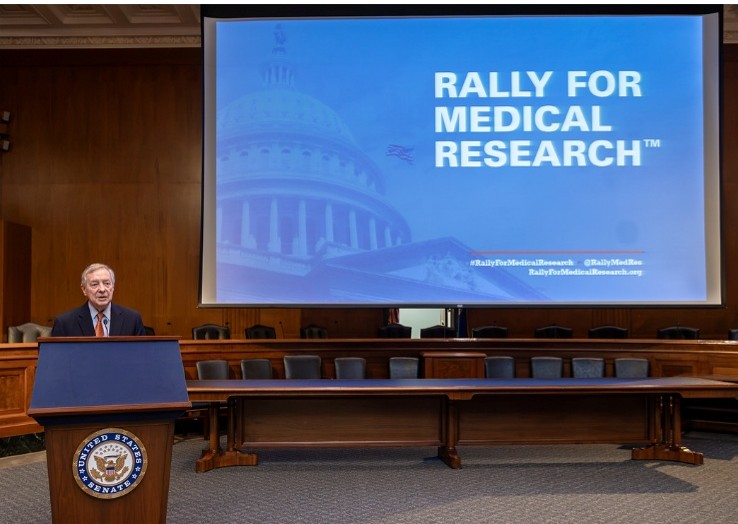
Senator Dick Durbin (D-Illinois)

Senior member of the Senate Appropriations Committee, Senator Dick Durbin (D-Illinois) provided remarks at the event’s reception,  praising the medical research community for mobilizing against significant reductions to federal research funding and echoing the call for Congress to fund NIH at no less than $51.3 billion in fiscal year 2027. NIH director Jay Bhattacharya also attended, highlighting scientific opportunities that improve health and save lives. Bhattacharya was joined by 17 influential leaders from the NIH. 

“NIH is the nation’s engine for behavioral, biological, and social science research,” said Adrienne Stith, APA’s executive lead psychologist for science.  She noted that “psychological science advances health, reduces disparities, strengthens evidence-based care, and helps translate biomedical discoveries into real-world improvements.”
Advocacy in practice

Reflecting on his experience, Bauer noted that participating in the Rally for Medical Research Hill Day “was an incredible experience, one that we don’t often get in academia, and I would highly recommend it to others who have the opportunity.” He shared that the “best part of the day was the people I got to meet, particularly advocates with lived experience who could speak to the direct impact NIH funding has had on their lives.” In each meeting, Bauer noted, he emphasized that sustained federal investment enables high-quality science, helps retain talented researchers in these fields, and lays the groundwork for the treatment and programs that improve people’s lives, often years before their benefits are realized. 

For Lam, an early-career psychologist, the Rally for Medical Research Hill Day showed how professional expertise, personal perspective, and coordinated messaging strengthen advocacy. “I got to voice my concerns about science funding in front of members of Congress and their staffers. I learned about the art of communicating and connecting science to politics, and I got to do it with my team who came from a variety of backgrounds.”

The meetings reinforced the value of collaborative advocacy. Lam emphasized mental health research and the perspective of an international scientist, while others described early-career research challenges, pairing evidence with lived experience to make a stronger case for federal investment. One meeting was especially memorable for Lam; Representative Joseph Courtney (D-Connecticut) joined the discussion in person and responded thoughtfully, demonstrating the value of respectful dialogue between researchers and policymakers.

Making the case for mental health research

Lam emphasized that NIH-supported mental health research improves lives and that stable funding helps attract and train scientific talent. He noted that mental health research can reduce distress, suicide risk, harmful behavior, and burdens on patients, families, and communities.

“Improving mental health treatments will ultimately save lives by reducing suicide rates and antisocial behaviors,” Lam said, adding that psychology also helps address chronic pain, anxiety, stress, and overall well-being.

Supporting the research workforce pipeline

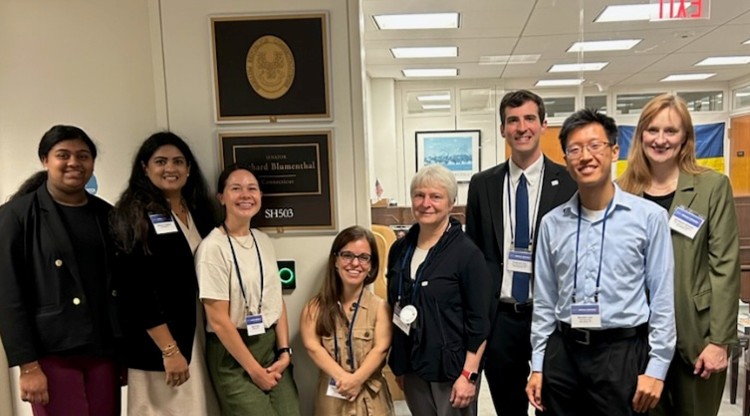
Brendan Lam, a member of APA’s Board of Scientific Affairs, with fellow advocates at the 2026 Rally for Medical Research Hill Day.

Brendan Lam (second from right) with fellow advocates at the 2026 Rally for Medical Research Hill Day.

Lam also urged congressional staff to recognize the fragility of the research workforce pipeline. “Researchers are leaving more frequently to pursue more profitable, stable jobs outside of research and innovation,” he said. Sustained federal investment, he emphasized, is essential to keeping research careers viable, rewarding, and competitive.

For more information, email Angela L. Sharpe.

Related and recent