


skip to main content
Artificial intelligence

APA urges Senate to regulate AI chatbots, citing grave risks to youth development

APA urges lawmakers to protect kids and adolescents from the risks of artificial intelligence
APA Style leaf logo Cite This Article in APA Style
American Psychological Association. (2025, September 16). APA urges Senate to regulate AI chatbots, citing grave risks to youth development. https://www.apaservices.org/advocacy/news/chatbots-testimony

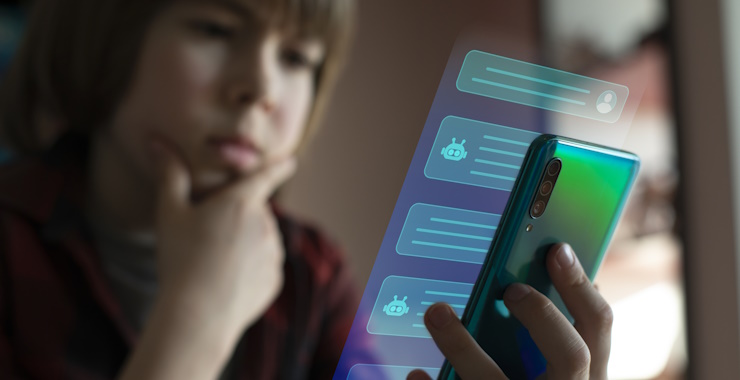
Young boy using system AI Chatbot on mobile application

Warning that the nation cannot repeat the mistakes made with social media, the American Psychological Association today called on Congress to establish immediate regulatory guardrails for artificial intelligence chatbots to protect the mental health and well-being of young people.

Testifying before the U.S. Senate Judiciary Committee, Subcommittee on Crime and Counterterrorism, APA Chief of Psychology Mitch Prinstein, PhD, ABPP, argued that AI must be reframed as a public health and human development issueopens in new window, not merely a technological one. "To view AI as a purely technological issue is to miss its most fundamental characteristic," Prinstein said. "AI is a tool built by humans, to be integrated into human systems, with profound and direct effects on human cognition, behavior, emotion, and interaction."

A digital Wild West for developing minds

Prinstein's testimony (PDF, 245KB)opens in new window detailed the unique psychological vulnerabilities of youth in the face of a "digital Wild West" of unregulated, direct-to-consumer AI products.

For adolescents (ages 10-25), this period is a time of profound brain development, making them uniquely susceptible to exploitation. The brain's reward centers mature faster than its executive control centers, creating what Prinstein described as an "all gas pedal and weak brakes" scenario. AI chatbots, with their incessant praise and frictionless interactions, are exquisitely engineered to exploit this biological vulnerability, leading to significant harms:

  • Erosion of social skills: Every hour spent with a chatbot is an hour not spent developing critical social competencies with human peers—skills essential for lifelong health and success.
  • Damaging relational models: Human relationships build resilience and empathy by navigating disagreements. The constantly agreeable nature of AI fails to prepare adolescents for the complexities of real-world interactions.
  • Deceptive and manipulative design: Some chatbots are intentionally designed to trick teens into believing they are human, betraying their trust at a vulnerable developmental stage.

For young children (ages 0-6), AI-powered toys pose a foundational risk by potentially disrupting the critical caregiver-child bonds necessary for healthy brain development. Because young children struggle to distinguish fantasy from reality, they can form powerful one-sided "parasocial" relationships with AI companions they believe are real.

Unregulated products, unacceptable dangers

Prinstein warned that the current marketplace is flooded with unregulated products making deceptive claims with no oversight. He highlighted a chilling example from the platform Character.ai, where a chatbot posing as a "psychologist" appeared to validate a user's violent thoughts. This represents an "unambiguous and unacceptable danger," especially as adolescents are increasingly trusting AI over parents, teachers, and doctors.

Furthermore, teens are incapable of providing meaningful informed consent for the vast and opaque data collection practices used by AI companies. Their most intimate disclosures about mental health, sexuality, and personal fears are being recorded and analyzed to build permanent psychological profiles, turning their vulnerabilities into a commercial asset.

APA’s recommendations for a human-centered AI

To address these imminent threats, Prinstein outlined a series of evidence-based recommendations for congressional action, urging lawmakers to build a framework for safety and accountability. The APA urges Congress to:

  • Establish clear regulatory guardrails: Make it illegal for any AI chatbot to misrepresent itself as a licensed professional and mandate clear, conspicuous, and persistent disclosure that users are interacting with an AI system.
  • Prioritize the protection of young people: Require that AI systems accessible to youth undergo rigorous, independent, pre-deployment testing for psychological harms. Protections for young people, such as the highest privacy settings, must be the default, not an option buried in a menu.
  • Invest in independent research: Authorize a significant and sustained federal investment in independent, longitudinal research to understand the impacts of AI on child and adolescent development and mental health.
  • Enact comprehensive data privacy legislation: Pass a strong federal privacy law that explicitly prohibits the sale of minors' data and provides robust legal protections against the non-consensual creation of "deepfakes."

"The core mission of health care—to help and do no harm—must be our guiding principle," concluded Prinstein. "The APA and its member scientists stand ready to collaborate with this subcommittee and the entire Congress to build a future where AI is safe, equitable, and promotes human flourishing."

Read the full testimony (PDF, 245KB)opens in new window.

For more information, contact Corbin Evans.

You may also like