


On March 23, 2023, APA Chief Advocacy Officer Katherine B. McGuire, MSc, appeared before the House Appropriations Labor, Health and Human Services, and Education Subcommitteeopens in new window to thank Congress for their support of mental health and remind them that more must be done to address the mental health crisis among youth via the president’s FY24 budget. APA Services was the sole mental health association invited to testify.
American Psychological Association. (2023, March 30). Testifying to support increased funding to address the mental health crisis. https://www.apaservices.org/advocacy/news/increased-funding-mental-health-crisis
A primer on the president’s budget
The president’s budget is typically considered a starting point for negotiations on how to fund the federal government. A divided Congress and the need to raise the debt ceiling will make negotiations for FY24 (which begins October 1, 2023) that much more challenging. Further complicating matters are demands from the House Freedom Caucus, a group of three dozen conservative members of Congress, to roll back federal funding to FY22 levels, which would amount to significant cuts to most programs, especially those in health care and education. This across-the-board cut strategy ignores the role of authorizing committees whose responsibility is to assess programs for their value and impact. House Democrats and the Biden administration have pushed back against the proposal, calling the cuts potentially devastating to millions of Americans and impacting everything from Pell Grants to Head Start to nutrition programs. Additionally, returning to FY22 funding levels would roll back the investments in mental health and research in recent years.
APA Services is actively working with our coalition partners to fight cuts that will further exacerbate the mental health crisis. The association has signed on to several coalition letters asking Congress to protect access to critical services (PDF, 90KB)opens in new window and invest in much needed research on youth mental health (PDF, 122KB)opens in new window.
APA Services’ priorities
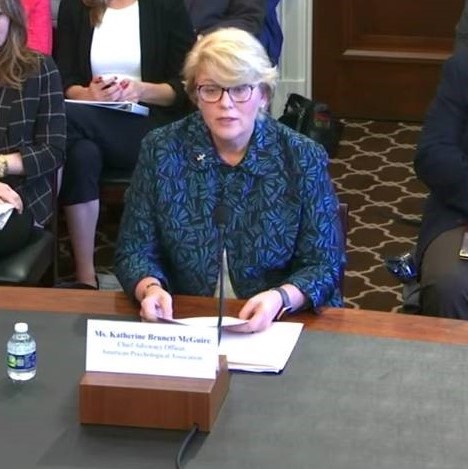 In her testimony, McGuire described a nation suffering from mental health concerns and providers dealing with increased workloads and burnout. McGuire recommended increased investments to address these concerns and shore up the mental health workforce. Shortages have been reported in every state, with severe cases in rural areas in the south. McGuire pressed for increased investments in the National Institute for Mental Health (NIMH), and more research on youth and school-based mental health as well as programs promoting evidence-based models of integrated primary and behavioral health care.
Among our priorities:
- Research: Requesting at least $50.924 billion for the National Institutes of Health and a $200 million increase for the NIMH to help combat the growing youth mental health crisis, including $20 million for the study of the mental health impacts of social media.
- Collaboration: APA Services supports language directing NIMH to collaborate with the National Institute of Child Health and Human Development and the National Institute on Minority Health and Health Disparities.
- Workforce: To address workforce shortages, APA Services supports an increase in funding for the Graduate Psychology Education Program, the Behavioral Health Workforce Education and Training Program, the Integrated Substance Use Disorder Training Program, and the Minority Fellowship Program.
- Social determinants of health: APA Services supports funding for the Centers for Disease Control and Prevention’s (CDC) Social Determinants of Health effort, which will provide tools that support community efforts to improve health.
- Rural health: APA Services supports funding for the CDC’s Office of Rural Health to address unique rural health care needs, coordinate efforts across the CDC’s portfolios, tailor scientific and communications resources, and improve public health functions and service delivery.
In testimony submitted to the Hearing record (PDF, 197KB)opens in new window, McGuire said, “Improving the health of the entire population requires an expansion of where we see interventions occurring across the entire continuum of behavioral health needs and how they are carried out. Successfully addressing the health inequities caused and exacerbated by the pandemic requires a fundamental shift in how we approach behavioral health and that is where we bring forth the robust body of psychological science to demonstrate the importance of behavioral health in improving population health.” McGuire concluded her testimony by declaring that psychologists stand ready to work with Congress to address our country’s mental health crisis.
For more information, contact Stefanie Reevesopens in new window.