


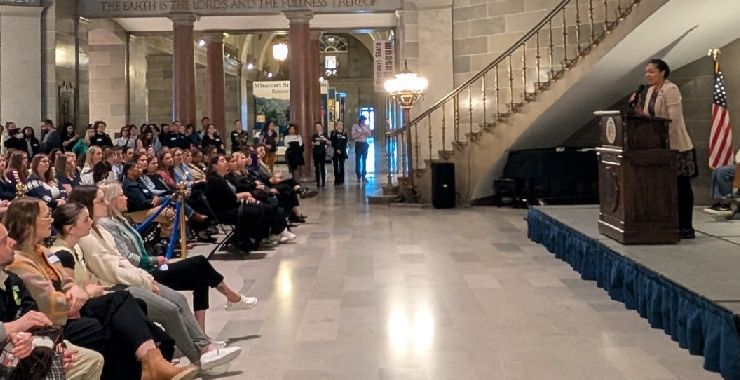
On March 4, 2025, the Missouri Psychological Association (mopa) sent a record 30 advocates to the state capitol, Jefferson City, for its annual Legislative Day. It was also the second year MOPA held Legislative Day jointly with the Missouri Behavioral Health Coalition, a group initiated by mopa, that includes the National Association of Social Workers-Missouri Chapter (NASW-MO) and the Missouri Mental Health Counselors Association (MMHCA).
MOPA members pose for a photo inside the Missouri Sate Capitol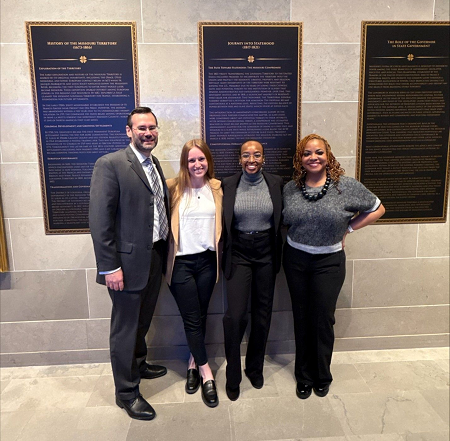
Mopa CEO, Chuck Hollister, PhD, also organized a small special team of experienced psychologist-advocates to discourage the adoption of an emerging bill that would negatively impact psychologists by collapsing educational levels in insurance reimbursement. APA Services offered consultation services in support of this effort.
Mopa legislative chair and federal advocacy coordinator, Amy R. Beck, PhD, welcomed participants in the capitol rotunda alongside representatives of NASW-MO and MMHCA. Missouri Representatives Aaron Crossley (D-29), a social worker by training, and Melanie Stinnett (R-133), a speech and language pathologist by training, addressed the group. The primary message was the necessity of using mental health training and expertise to benefit residents of the state by impacting legislation.
Amy Beck, PhD, with fellow MOPA members and MO State Rep. Pattie Mansur during the Legislative Day
Before the Legislative Day, mopa advocates participated in an advocacy training led by Beck. The training focused on the basics of the state legislative process, the current climate of the legislative session, the background of the two bills with the specific legislative asks, what to expect in a legislative meeting, and practical basics for the day, such as what to wear and where to park. Advocates were organized into delegations by senator/geographic area, and each group included at least one psychologist with previous legislative advocacy experience. Because of the limited resources in a small association, advocates were expected to schedule their legislator visits. Email templates for how to request visits and how to follow up after a visit were provided in a handbook sent to all advocates. Advocates also submitted electronic feedback from each legislative visit for follow-up as needed by mopa. Beck modeled much of this process from the Capitol Hill fly-ins sponsored by APA Services.
While the outcomes of these bills will not be known until later in the session, which ends on May 16, the 2025 mopa Legislative Day was a success for psychology advocacy and a big step forward for increasing access to care in Missouri. More legislators were educated about these important bills, relationships between advocates, legislators, and coalitions were strengthened, and more psychologists got hands-on experience using mental health expertise for legislative advocacy.
For more information on state advocacy efforts, contact Alix Ginsberg.