


skip to main content

Psychologists find ever-expanding uses for virtual reality

Long used to help treat anxiety, psychologists are now showing VR can be a transformative tool for mood disorders, addictions, and even schizophrenia
APA Style leaf logo Cite This Article in APA Style
Medaris, A. (2025, May 12). Psychologists find ever-expanding uses for virtual reality. https://www.apaservices.org/practice/news/psychologists-uses-virtual-reality

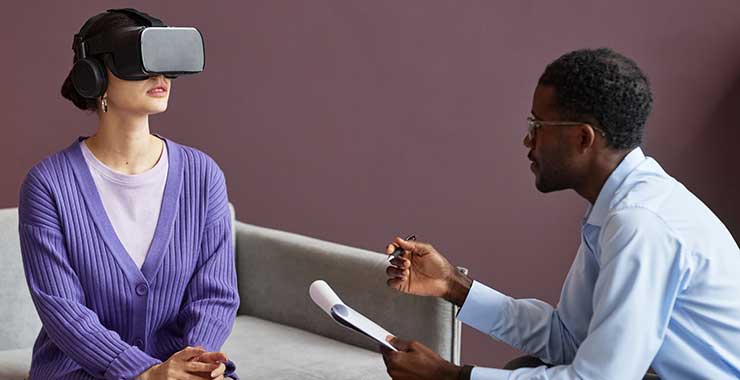
woman using virtual reality headset

It was about 8:30 p.m. on a winter night in Indianapolis when a powerful idea struck Brandon Oberlin, PhDopens in new window. The addiction researcher and assistant professor of psychiatry at Indiana University had come across a study at Stanford University showing that when people used virtual reality to interact with renderings of their future selvesopens in new window, they were more likely to delay immediate monetary rewards and accept later ones. In other words, they were more motivated to save money when their future selves felt more real.

Oberlin began pacing. “What if I did this with people in early recovery? Has that been done? Could it be done?” He remembers thinking. “It really was like one of those late-night-in-the-lab eureka moments.”

Turns out, it hadn’t been done and, Oberlin learned, could be done. Over the next 6 or so months, he partnered with local developers to create a virtual-reality technology that introduces people in early recovery to two selves 15 years down the line—one who continued using drugs and/or alcohol (“my husband left me, I got another DUI”) and one who has stuck with sobriety (“life is good, I got that degree”). The avatars’ programming is all based on participants’ real experiences and aspirations. “It’s not scolding; it’s just telling you: Hey, this is reality,” Oberlin said.

The intervention—which later sends participants daily photo reminders of their recovered future selves—increases future-self continuity and doubles the ability to delay rewards, his 2022 pilot study showedopens in new window. Eighteen of the 21 original participants remained abstinent 30 days later too. “I don’t listen to the police. I don’t listen to my probation officer. I don’t listen to counselors. I don’t listen to anyone else on the street,” one participant told Oberlin after the simulation. “The only one I trust is me, but you’ve got me giving me good advice. I can hear that.” Put another way, the patient experienced a strong therapeutic alliance with his best self.

Since then, Oberlin’s team’s work has spun into a startup called Relate XRopens in new window , which is currently in clinical trialsopens in new window. While starting a business as a lab rat by nature has had its challenges, Oberlin and other psychology researchers and clinicians encourage their colleagues to embrace virtual reality as a tool for an ever-expanding repertoire of therapeutic applications. “The only limits to this is that of our imaginations—and our clinical acumen,” said Albert “Skip” Rizzo, PhDopens in new window, a research psychologist at the University of Southern California, where he directs the Medical Virtual Reality program.

Wide-ranging clinical applications

Thanks to a handful of psychologists, including Barbara Olasov Rothbaum, PhD, virtual reality has been used as an effective treatment for anxiety disordersopens in new window, including phobias and posttraumatic stress disorder, since the 1990s. It’s an especially helpful exposure therapy delivery method for fears like flying, heights, or other scenarios that are difficult, dangerous, or expensive to repeatedly expose people to in real life.

In addition to immersing patients in a simulated environment, virtual reality can allow clinicians to monitor some physiological markers, like heart rate and skin temperature, during the experience. That strategy helps inform the therapist and empower the patient, said Brenda Wiederhold, PhDopens in new window, a clinical health psychologist and cofounder of the Virtual Reality Medical Center in San Diego. Her 2002 randomized controlled clinical trialopens in new window showed that people with a fear of flying who underwent virtual reality exposure therapy had weaker physiological reactions as the sessions went on, and were eventually able to fly without medication. A follow-up study showed the group receiving virtual reality and biofeedback had maintained their ability to flyopens in new window three years later.

“When they become aware of their body’s reaction to different experiences in the virtual world or in the real world, they can do something to attenuate that,” said Wiederhold, editor-in-chief of the journal Cyberpsychology, Behavior, and Social Networking.

Since those early days, the technology has only evolved. Now, Wiederhold says, patients can receive treatment at home through VR headsets if, for instance, they live in a rural area or have agoraphobia. Clinicians can still monitor their physical symptoms using tools like smart watches. “We’re now able to so easily and inexpensively transition from the hospital or the clinic to the home, to the office, with validated tools, and we didn’t have those back then,” Wiederhold said.

Virtual reality’s uses have expanded far beyond anxiety disorders in the past few decades, too. Cheri Levinson, PhDopens in new window, a professor in the department of psychological and brain sciences at the University of Louisville, and collaborators, have shown that virtual reality can help people with eating disorders face fears of weight gain. This work was done by Levinson and her Eating Anxiety Treatment Lab, including University of Louisville colleagues Christina Ralph-Nearman, PhD, and Andrew Karem, PhD, and was recently awarded a $125,000 grantopens in new window from the National Eating Disorder Association that will help make the platform more inclusive of various body sizes, races, and gender identities

“For things like anorexia nervosa in adults, which is where we see this really crippling fear of weight gain, we don’t have treatments that work well—our best response rates are about 50%,” Levinson said. “If we can figure out a way to really address this fear, we’re going to make so much progress in treating these illnesses.”

Mood disorders, too, seem to be a ripe area for virtual reality interventions. In one 2024 randomized controlled trialopens in new window out of Stanford Medicine’s Virtual Reality and Immersive Technology Programopens in new window, Margot Paul, PhDopens in new window, and colleagues compared traditional behavioral activation (BA)—or exposing people to values-based activities they enjoy or that give them a sense of accomplishment—to BA delivered via virtual reality. “We were curious if simulating pleasurable activities could improve mood similar to engaging in these real-life activities,” Paul said.

The research team found that mood significantly improved in both groups, and that the virtual reality participants experienced a lift before even beginning treatment that the control group did not, perhaps because they were excited to experience a new kind of therapy, Paul theorizes.

Psychologists are even rethinking long-held beliefs preventing them from testing virtual reality interventions on people with schizophrenia or other psychotic disorders. While psychologists used to think that such experiences would only trigger or enhance hallucinations for these patients in a potentially dangerous way, a 2024 trial out of the United Kingdomopens in new window showed the therapies, with appropriate therapist supervision, have the potential to actually help quiet auditory hallucinations.

Whereas with autism, you can turn up the volume on sensory experiences to build up a tolerance toward them, Wiederhold said, with psychosis, “you can turn down the volume of those auditory or visual hallucinations, and you can teach patients what’s real and what’s part of their schizophrenia.”

Beyond treatments for mental illness

You don’t need a diagnosable disorder to benefit from virtual reality interventions, psychologists say. For his part, Rizzo has shown how medical students and therapists-in-training can use it to practice aspects of their craft, like learning to get comfortable with uncomfortable silences and doing intake on a new patient.

“You’re not just doing a hard interview, you’re doing a clinical interview with somebody who’s perhaps had extreme trauma, and you’ve got to be thoughtful and empathetic, but also not be afraid to engage, but also not be pushy. That’s an art,” he said. Put bluntly: “Give novice clinicians a chance to screw up a bunch with a virtual patient before they get their hands on a live one.”

Similarly, he’s used virtual reality to help people with autism secure jobs. “With higher-functioning folks on the spectrum that [are] capable of working, they [aren’t always] so capable of job interview success,” Rizzo said. But after practicing in various computed worlds, like those representing the restaurant industry or an office job, vocational counselors saw dramatic improvements in participants’ ability to talk about their strengths, answer situational questions, and respond to other common job-interview questions, Rizzo and colleagues’ 2018 study foundopens in new window. “What was learned in virtual reality can transfer to the real world,” Rizzo said.

Even the general population can use virtual reality as a stress management tactic or to potentially prevent a more significant mental health disorder from developing in the future, Wiederhold said. In one study conducted during the pandemic, she and colleagues tested a virtual reality interventionopens in new window on people in Italy who’d been subject to at least two months of strict social distancing. The researchers found that the daily, at-home modules that immersed participants in soothing environments and allowed them to practice social tasks decreased their anxiety, stress, and depressive symptoms over the course of a week—and 2 weeks beyond.

Keepers of the tool

Like any therapeutic delivery method, virtual reality has its limitations. You can’t simply put a headset on someone who might get retraumatized, for instance, without warming them up with other exercises like visualizations first. “It’s a tool, and we are the keepers of that tool, and we need to make sure it’s done ethically and responsibly,” Wiederhold said.

Plus, it can be expensive. Paul says that, in some ways, it’s less accessible than it used to be since companies with headsets and subscription services have monopolized the platforms. And while “you don’t need to be a tech expert—just clinically curious,” Wiederhold said, building programs that can be patented and rolled out for real-world use requires connections, time, money, and a skillset many psychologists don’t yet have. “There’s a real gap between people who are building it and people who are testing it and using it for real-world applications,” Oberlin said.

That’s why he recommends partnering with people whose experience and interests complement your own and being deliberate about how you use virtual reality in practice. “I would caution people not to use virtual reality simply because it’s the latest toy; it seems like a whiz-bang, whistles and bells kind of thing,” Oberlin added. “Use it for what it’s good for, which is doing things that are impossible or unrealistically expensive or maybe dangerous. These are the use cases where virtual reality really excels.”