skip to main content

What are principal illness navigation services?

Principal illness navigation (PIN) services were developed by the Centers for Medicare & Medicaid Services (CMS) to assist patients with serious conditions in navigating their health care treatment. Two HCPCS codes—G0023 and G0024—describe PIN services, and two HCPCS codes—G0140 and G0146—describe PIN-peer support (PIN-PS) services, which are intended more for patients with high-risk behavioral health conditions and have slightly different service elements that better describe the scope of practice of peer support specialists.

PIN services are a type of care management service that auxiliary personnel, including care navigators or peer support specialists, may perform incidental to the professional services of a physician or other billing practitioner, under general supervision, to help patients understand their medical condition or diagnosis and guide them through the health care system. These services are designed for individuals with serious conditions that are expected to last at least 3 months, including but not limited to cancer, chronic obstructive pulmonary disease, congestive heart failure, HIV/AIDS, severe mental illness, or substance use disorder (SUD). Patients who are at high risk for hospitalization, nursing home placement, sudden worsening of preexisting symptoms, physical or mental decline, or death can benefit from PIN services.

Why are PIN services important?

PIN services offer several benefits to patients with serious medical and mental health conditions. Some key advantages include:

  1. Guidance and support: Patients receive personalized guidance and support throughout their health care journey. Navigators help them understand their diagnosis, treatment options, and available resources.
  2. Coordination of care: Navigators coordinate care among different providers, ensuring seamless communication and collaboration. This reduces the risk of fragmented care and improves overall outcomes.
  3. Access to services: Patients gain access to essential services, such as transportation, housing assistance, and mental health support. Navigators connect them with community resources and address barriers to care.
  4. Empowerment: PIN empowers patients to actively participate in their health decisions. Navigators educate them about self-management, symptom monitoring, and preventive measures.
  5. Reduced hospitalizations: By proactively managing patients’ health, PIN services can reduce hospital admissions and emergency room visits. This leads to cost savings and better quality of life.
  6. Emotional support: Navigators provide emotional support, helping patients cope with the emotional and psychological aspects of their illness. This can positively impact mental well-being.
  7. Advocacy: Navigators advocate for patients’ needs, ensuring they receive appropriate care and services. They address insurance issues, medication access, and other challenges.

Core components of PIN services

There are four HCPCS codes specifically related to PIN services:

Principal illness navigation services

  • G0023: Principal illness navigation services by certified or trained auxiliary personnel under the direction of a physician or other practitioner, including a patient navigator; 60 minutes per calendar month
  • G0024: This code captures each additional 30 minutes of PIN services per patient per month beyond the initial 60 minutes provided by G0023.

Principal illness navigation-peer support (PIN-PS) services

  • G0140: Principal illness navigation peer support provided by certified or trained auxiliary personnel under the direction of a physician or other practitioner, including a certified peer specialist; 60 minutes per calendar month
  • G0146: This code captures each additional 30 minutes of PIN-PS services per patient per month beyond the initial 60 minutes provided by G0140.

Providing PIN services involves several steps to ensure effective patient support:

1. Informed consent

2. Before initiating PIN services, the patient must agree to receive them. The billing practitioner or the auxiliary personnel under supervision can obtain consent, either in writing or verbally, but it must be documented in the patient’s record. Consent must also be obtained annually thereafter.

Initiating visit: An initiating visit is required before starting PIN services. A health care practitioner initiates PIN services during an initiating visit where they identify the medical necessity of PIN services and establish an appropriate treatment plan. The same practitioner bills for the subsequent PIN services that auxiliary personnel provide. The billing practitioner personally performs initiating visits.

The type of initiating visit depends on the provider:

For clinical psychologists, CPT® code 90791; Psychiatric diagnostic evaluation or Health Behavior Assessment and Intervention (HBAI) services (codes 96156, 96158, 96159, 96164, 96165, 96167, and 96168) can serve as the initiating visit.

Social workers and other therapists cannot bill for PIN services, as they are not eligible under Medicare to report incident to services.

3. Core components of PIN services:

  • Person-centered assessment: Understand the patient’s life story, strengths, needs, goals, preferences, and desired outcomes.
  • Goal setting and action plans: Work with patients to establish personalized goals and create action plans.
  • Identify or refer to supportive services: Connect patients to appropriate supportive services.
  • Care coordination: Coordinate services from various health care providers.
  • Communication and coordination: Facilitate communication among practitioners and providers.
  • Care transitions: Ensure smooth transitions between different health care settings
  • Access to social services: Help patients access community-based services.
  • Health education: Contextualize health education for patients.
  • Self-advocacy skills: Empower patients to participate effectively in medical decision-making.
  • Health care access and system navigation: Assist patients in accessing appropriate health care.
  • Behavioral change facilitation: Support necessary behavioral changes.
  • Social and emotional support: Help patients cope with their condition and adjustments to daily routines

Certification requirements

Auxiliary personnel, such as patient navigators and community health workers, must meet applicable state requirements, including certification or licensure. In states with no applicable requirements, auxiliary personnel providing PIN services must be trained or certified in the competencies of:

  • Patient and family communication
  • Interpersonal and relationship-building
  • Patient and family capacity building
  • Service coordination and systems navigation
  • Patient advocacy, facilitation, individual and community assessment
  • Professionalism and ethical conduct
  • Developing an appropriate knowledge base, including specific certification or training on the serious, high-risk condition, illness, or disease being addressed.

For auxiliary personnel performing PIN-PS services (HCPCS codes G0140 and G0146), if no applicable state requirements exist, they must be trained consistent with the National Model Standards for Peer Support Certification published by the Substance Abuse Mental Health Services Administration (SAMHSA).

How do PIN services connect to APA initiatives?

APA is dedicated to improving population health, along with advocating for financial incentives that support psychologists’ involvement in these efforts. A population health approach, or preventive health approach, focuses on improving the health, health equity, safety, and well-being of entire populations, including individuals within those populations.

Principal illness navigation (PIN) services play a significant role in addressing population health by providing personalized support and guidance to individuals with serious medical/mental health conditions. They ensure that patients receive comprehensive and effective support throughout their health care journey. Providing PIN services contributes to healthier populations by addressing individual needs, promoting equity, and enhancing overall well-being.

Clinical example

Patient encounter

  • Patient: John, a 65-year-old man recently diagnosed with congestive heart failure (CHF).
  • Health condition: John’s CHF requires ongoing management, including medication adjustments, lifestyle modifications, and regular follow-up visits.
  • Challenges: John is overwhelmed by the complexity of his treatment plan, struggles with medication adherence, and faces transportation barriers to medical appointments.

Psychologist’s role

Initiating visit:

  • John is referred by his physician to a clinical psychologist for emotional support and coping strategies related to his CHF diagnosis.
  • The psychologist conducts an in-depth assessment, discussing John’s medical history, symptoms, and psychosocial factors.
  • During this visit, the psychologist identifies John’s need for additional support in managing his CHF.

PIN services initiation:

  • The psychologist establishes a care plan that includes PIN services.
  • The psychologist explains the role of a patient navigator (auxiliary personnel) who will assist John in navigating his health care journey.
  • The patient navigator will work under the psychologist’s general supervision.

Patient navigator’s responsibilities:

  • Medication adherence (10 minutes): The patient navigator educates John about his CHF medications, emphasizing the importance of consistent adherence. They provide reminders, pill organizers, and connect John with pharmacy services.
  • Transportation assistance (10 minutes): Recognizing John’s transportation challenges, the patient navigator arranges transportation services for his medical appointments. They coordinate with community resources or volunteer programs.
  • Coordination with specialists (15 minutes): John’s CHF management involves multiple specialists (cardiologist, dietitian, and physical therapist). The patient navigator ensures seamless communication among these providers.
  • Emotional support (15 minutes): John experiences anxiety related to his diagnosis. The patient navigator provides emotional support, addressing his fears and concerns.
  • Access to social services (10 minutes): The patient navigator connects John with local resources for housing, utilities, and food assistance. They address social determinants of health (SDOH) needs.

Billing and documentation:

  • For the initiating visit the psychologist bills CPT Code 96156; Health behavior assessment or re-assessment, which includes health-focused clinical interviews, behavioral observations, and clinical decision-making.
  • The psychologist bills for PIN services incident-to their services using HCPCS code G0023 (60 minutes per calendar month).
  • The patient navigator’s time spent with John is documented in the patient’s record.

Outcome

John receives personalized support, improves medication adherence, attends follow-up appointments, and experiences reduced anxiety. The collaborative efforts of the psychologist and patient navigator enhance John’s overall well-being and quality of life.

Billing and coding guidance

  • Beneficiary consent is required to be obtained prior to initiating PIN services. The billing practitioner or the auxiliary personnel under supervision can obtain consent, either in writing or verbally, but it must be documented in the patient’s recordopens in new window. Consent must also be obtained annually thereafter.
  • An initiating visit is required before starting PIN services. A health care practitioner initiates PIN services during an initiating visit where they identify the medical necessity of PIN services and establish an appropriate treatment plan. The same practitioner bills for the subsequent PIN services that auxiliary personnel provide. The billing practitioner personally performs initiating visits.
  • The type of initiating visit depends on the provider. For clinical psychologists, services that can serve as initiating visits include:
    • CPT® code 90791; Psychiatric diagnostic evaluation
    • Health Behavior Assessment and Intervention (HBAI) services (codes 96156, 96158, 96159, 96164, 96165, 96167, and 96168)
  • Bill for PIN services incident-to the psychologist’s services using G0023, G0024, or G0140 and G0146.
  • Ensure accurate documentation of the services provided during each session in the patient’s record, as well as the amount of time auxiliary personnel spent with the patient.
  • PIN services cannot be provided more than once per practitioner per month for any single serious high-risk condition, to avoid duplication of PIN service elements when utilizing the same navigator or billing practitioner.
  • PIN and PIN–PS should not be billed concurrently for the same serious, high-risk condition. Beneficiaries can receive more than one PIN service at a time, as long as the services are not treating the same condition or furnished by the same practitioner.
CPT® Code Descriptor 2024 wRVU 2024 Medicare Non-Facility Payment 2024 Medicare Facility Payment

Principal illness navigation (PIN) services

G0023

Principal illness navigation services by certified or trained auxiliary personnel under the direction of a physician or other practitioner, including a patient navigator; 60 minutes per calendar month, in the following activities:

Person-centered assessment, performed to better understand the individual context of the serious, high-risk condition

  • Conducting a person-centered assessment to understand the patient’s life story, strengths, needs, goals, preferences, and desired outcomes, including understanding cultural and linguistic factors and including unmet SDOH needs (that aren’t separately billed)
  • Facilitating patient-driven goal setting and establishing an action plan
  • Providing tailored support as needed to accomplish the practitioner’s treatment plan

Identifying or referring patient (and caregiver or family, if applicable) to appropriate supportive services

Practitioner, home- and community-based care communication

  • Coordinating receipt of needed services from health care practitioners, providers, and facilities; home- and community-based service providers; and caregiver (if applicable)
  • Communicating with practitioners, home- and community-based service providers, hospitals, and skilled nursing facilities (or other health care facilities) regarding the patient’s psychosocial strengths and needs, functional deficits, goals, preferences, and desired outcomes, including cultural and linguistic factors
  • Coordination of care transitions between and among health care practitioners and settings, including transitions involving referral to other clinicians; follow-up after an emergency department visit; or follow-up after discharges from hospitals, skilled nursing facilities or other health care facilities
  • Facilitating access to community-based social services (e.g., housing, utilities, transportation, food assistance) as needed to address SDOH need(s)

Health education—helping the patient contextualize health education provided by the patient’s treatment team with the patient’s individual needs, goals, preferences, and SDOH need(s), and educating the patient (and caregiver if applicable) on how to best participate in medical decision-making

Building patient self-advocacy skills, so that the patient can interact with members of the health care team and related community-based services (as needed), in ways that are more likely to promote personalized and effective treatment of their condition

Health care access/health system navigation

  • Helping the patient access health care, including identifying appropriate practitioners or providers for clinical care, and helping secure appointments with them
  • Providing the patient with information/resources to consider participation in clinical trials or clinical research as applicable

Facilitating behavioral change as necessary for meeting diagnosis and treatment goals, including promoting patient motivation to participate in care and reach person-centered diagnosis or treatment goals

Facilitating and providing social and emotional support to help the patient cope with the condition, SDOH need(s), and adjust daily routines to better meet diagnosis and treatment goals

Leveraging knowledge of the serious, high-risk condition and/or lived experience when applicable to provide support, mentorship, or inspiration to meet treatment goals

1.00

$80.56

$49.60

G0024

Principal illness navigation services, additional 30 minutes per calendar month (List separately in addition to G0023)

0.70

$50.26

$34.62

Principal illness navigation-peer support (PIN-PS) services

G0140

Principal illness navigation—peer support by certified or trained auxiliary personnel under the direction of a physician or other practitioner, including a certified peer specialist; 60 minutes per calendar month, in the following activities:

Person-centered interview, performed to better understand the individual context of the serious, high-risk condition

  • Conducting a person-centered interview to understand the patient’s life story, strengths, needs, goals, preferences, and desired outcomes, including understanding cultural and linguistic factors, and including unmet SDOH needs (that aren’t billed separately)
  • Facilitating patient-driven goal setting and establishing an action plan
  • Providing tailored support as needed to accomplish the person-centered goals in the practitioner’s treatment plan

Identifying or referring patient (and caregiver or family, if applicable) to appropriate supportive services

Practitioner, home, and community-based care communication

  • Assisting the patient in communicating with their practitioners, home- and community-based service providers, hospitals, and skilled nursing facilities (or other health care facilities) regarding the patient’s psychosocial strengths and needs, goals, preferences, and desired outcomes, including cultural and linguistic factors
  • Facilitating access to community-based social services (e.g., housing, utilities, transportation, food assistance) as needed to address SDOH need(s)

Health education

  • Helping the patient contextualize health education provided by the patient’s treatment team with the patient’s individual needs, goals, preferences, and SDOH need(s), and educating the patient (and caregiver if applicable) on how to best participate in medical decision-making

Building patient self-advocacy skills, so that the patient can interact with members of the health care team and related community-based services (as needed), in ways that are more likely to promote personalized and effective treatment of their condition

Developing and proposing strategies to help meet person-centered treatment goals and supporting the patient in using chosen strategies to reach person-centered treatment goals

Facilitating and providing social and emotional support to help the patient cope with the condition, SDOH need(s), and adjust daily routines to better meet person-centered diagnosis and treatment goals

Leveraging knowledge of the serious, high-risk condition and/or lived experience when applicable to provide support, mentorship, or inspiration to meet treatment goals

1.00

$80.56

$49.60

G0146

Principal illness navigation—peer support, additional 30 minutes per calendar month (List separately in addition to G0140)

0.70

$50.26

$34.62

National Correct Coding Initiative (NCCI) edits for PIN services

According to the most up-to-date NCCI Medically Unlikely Edits (MUE) and Practitioner-to-Practitioner (PTP) edits (effective July 1, 2024), there are no restrictions in place for reporting PIN services in conjunction with CPT codes 90791, 96156, 96158, 96159, 96164, 96165, 96167, or 96168. APA will update this section in the future if PTP and/or MUE edits are implemented.

How to report PIN services on your claim form

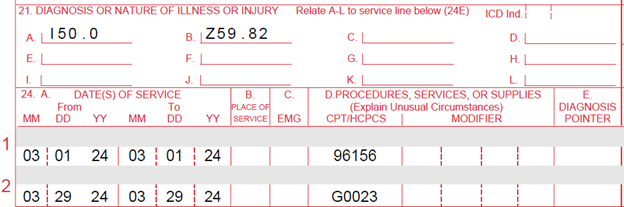
The following example depicts a patient who was diagnosed with congestive heart failure (ICD-10 code I50.0), and during the health behavior assessment (CPT code 96156), the psychologist identifies the patient’s need for additional support in managing his diagnosis. Once consent is obtained from the patient, the psychologist establishes a care plan that includes PIN services. Then, over the next month, the patient navigator (auxiliary personnel) spends 60 minutes assisting the patient with navigating through their health care journey, performing services such as coordinating with specialists, transportation assistance (Z59.82), and emotional support:

Image example of Principal Illness Navigation services on claim form

Date created: December 2024