


Psychologists can receive reimbursement from Medicare for providing early intervention services to individuals with substance use disorders. Screening, brief intervention, and referral to treatment (SBIRT) services can help reduce the likelihood that an individual with substance use will need more extensive or specialized treatment.
American Psychological Association. (2022, March 10). How to bill for brief substance and alcohol abuse services. https://www.apaservices.org/practice/reimbursement/health-codes/substance-alcohol-abuse-services

What are SBIRT services?
SBIRT services represent a comprehensive, integrated, public health approach to the delivery of early intervention and treatment services. These services can be provided in a variety of settings to help identify persons with substance use disorders and those whose use are at a higher risk for severe outcomes.
Why are SBIRT services important?
The goal of SBIRT is to identify and effectively intervene with patients who are at moderate or high risk for psychosocial and/or health care problems related to their substance use. Unhealthy and unsafe alcohol and drug use are public health problems resulting in:
- more than 100,000 preventable deaths each year
- $600 billion cost to society annually
- far-reaching implications for the individual, family, workplace, community, and the health care system
SBIRT services are effective and patients have demonstrated a willingness to discuss their substance use to improve their health.
SBIRT services have three core components
Screening
Screening (S) is a quick way of identifying patients with risky substance use behaviors using a brief 1–3 question screen such as the National Institute on Alcohol Abuse and Alcoholism’s single question screenopens in new window or National Institute on Drug Abuse’s quick screen (PDF, 181KB) opens in new window.
If a person screens positive on one of these instruments, follow-up with a longer alcohol or drug use evaluation, using a standardized risk assessment tool such as the World Health Organization’s Alcohol Use Disorders Identification Test (audit) (PDF, 224KB)opens in new window, Drug Abuse Screening Test (DAST) (PDF, 51KB)opens in new window, or the NIDA-Modified assist. The Substance Abuse and Mental Health Services Administration (SAMHSA) Screening Tools webpageopens in new window includes more information on SBIRT assessment and other screening tools.
Brief Intervention
Brief Intervention (BI) is a time-limited, patient-centered strategy that focuses on increasing insight and awareness regarding substance use and motivation toward behavioral change.
Psychologists can engage the patient in a short conversation to:
- increase awareness through information about their substance use based on their risk assessment score
- give feedback by advising the patient to decrease or abstain from substance use
- motivate by encouraging the patient to set goals to decrease substance use and to identify specific steps to reach those goals
- teach behavior change skills that will reduce substance use and limit negative consequences
Referral to Treatment
Referral to Treatment (RT) may be warranted in cases where a higher level of care, such as through specialized addiction treatment programs, is needed.
Psychologists can help patients in selecting treatment facilities and working through potential barriers such as treatment cost or transportation that might prevent them from receiving treatment in a specialty setting.
ADVERTISEMENT
How do SBIRT services connect to APA initiatives?
APA is dedicated to improving population health, along with advocating for financial incentives that support psychologists’ involvement in these efforts. A population health approach, or preventive health approach, focuses on improving the health, health equity, safety, and well-being of entire populations, including individuals within those populations. Providing SBIRT services is an important part of addressing population health, and SBIRT codes allow psychologists to be reimbursed for those services.
Additionally, integrating SBIRT services into routine practice is one way psychologists can address the opioid/substance abuse epidemic. Over 93,000 Americans died of a drug overdose in 2020, an increase of nearly 30% above 2019 deaths. While opioids, especially fentanyl, continue to account for the bulk of overdose deaths, many others are associated with the use of psychostimulants such as methamphetamine. A population health approach would focus on providing SBIRT services, with an emphasis on opioid use/substance abuse, as well as alcohol abuse.
Clinical examples
1. A psychologist sees a patient for an initial appointment. The patient completes the audit and DAST-10 as part of the standard intake paperwork. At the initial appointment the psychologist completes a diagnostic interview and provides SBIRT services. The patient’s audit results in a negative screen but the DAST results indicate harmful use related to opioids. The psychologist provides a brief intervention utilizing motivational interviewing techniques. The psychologist provides feedback on the screening results and engages the patient in a conversation around awareness of opioid use, negative consequences, and patient’s health. They also discuss the patient’s readiness to make changes in opioid use, which results in the patient asking for treatment options. They discuss treatment options and the psychologist assists with a referral for opioid abuse treatment. The psychologist spent 20 minutes providing the SBIRT services in addition to the diagnostic interview.
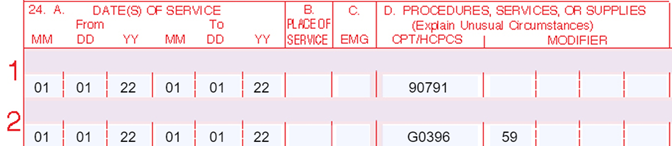
- Report CPT® code 90791 for the psychiatric diagnostic interview and G0396 indicating the performance of 15–30 minutes of SBIRT services.
2. A neuropsychologist is completing a neuropsychological evaluation. The patient completes the audit and DAST-10 as part of the standard intake paperwork. At the time of the feedback session the neuropsychologist provides feedback on the neuropsychological evaluation and provides SBIRT services. The patient’s audit results indicate “risky use” and the DAST results indicate “risky use.” The neuropsychologist provides a brief intervention utilizing motivational interviewing techniques. The neuropsychologist provides feedback on the screening results and engages the patient in a conversation around awareness of the patient’s alcohol and drug use, negative consequences, and patient’s health. Patient reveals recreational use of prescription medications without a medical reason, on occasion. They set goals to decrease alcohol and medication use and identify specific steps to reach these goals. They review behavior change skills that will reduce substance use and limit negative consequences. The psychologist spent 35 minutes providing the SBIRT services in addition to the feedback session.
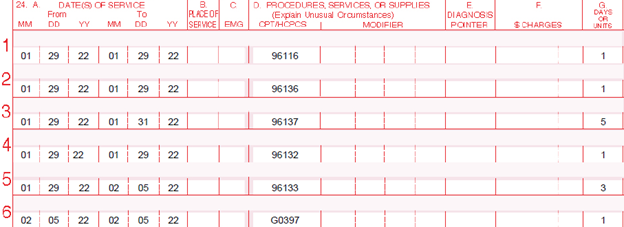
- Report CPT® codes 96132/+96133 for neuropsychological evaluation services and G0397 indicating the performance of 30 or more minutes of SBIRT services.
Billing and coding guidance
Psychologists should document the start and stop times or total face-to-face time with the patient because SBIRT codes are time-based services.
| CPT® Code | Descriptor | 2022 wRVU | 2022 Medicare Non-Facility Payment | 2022 Medicare Facility Payment |
| Screening, Brief Intervention, and Referral to Treatment (SBIRT) Services | ||||
| G2011 | Alcohol and/or substance (other than tobacco) abuse structured assessment (e.g., audit, DAST), and brief intervention, 5–14 minutes | 0.33 | $16.96 | $16.96 |
| G0396 | … 15–30 minutes | 0.65 | $35.99 | $32.88 |
| G0397 | … 31 or more minutes | 1.30 | $69.21 | $66.10 |
- Do not report SBIRT services for less than five minutes.
- When performed on the same date of service as a psychotherapy session, Modifier 59 will be needed to indicate that SBIRT was a distinct or independently performed service.
CPT® codes also exist to report SBIRT services. Medicare instructs psychologists to not report codes 99408 and 99409, and to use the appropriate G-code (G2011, G0396, or G0397) instead; however, APA is aware of commercial payers that prefer and will reimburse psychologists for reporting codes 99408 or 99409 on their claim form.
APA recommends that, in order to reduce the risk of your claim(s) being denied for reporting noncovered/noncontracted codes, you should check each commercial payer policy, as well as the list of codes included in your contract with each payer, to determine which codes are covered/reimbursed.
| CPT® Code | Descriptor | 2022 wRVU | 2022 Medicare Non-Facility Payment | 2022 Medicare Facility Payment |
| Screening, Brief Intervention, and Referral to Treatment (SBIRT) Services | ||||
| 99408 | Alcohol and/or substance (other than tobacco) abuse structured screening (eg, audit, DAST), and brief intervention (SBI) services; 15–30 minutes | 0.65 | $35.99 | $32.88 |
| 99409 | … greater than 30 minutes | 1.30 | $69.21 | $66.10 |
- Only 99408 OR 99409 can be reported, not both
- Do not report SBIRT services with Health Risk Assessment services (96160/96161)
- Codes 99408/99409 cannot be reported for the same patient, on the same date of service, as Health Behavior Assessment and Intervention (HBAI) services (96156, 96158/+96159, 96164/+96165, 96167/+96168)
National Correct Coding Initiative (NCCI) edits for SBIRT and psychological services
Currently psychologists are eligible to report SBIRT G-codes with the family of psychotherapy services (codes 90791, 90792, 90832, 90833, 90834, 90836, 90837, 90838, 90839, 90840, 90845, 90846, 90847), when reported with an appropriate NCCI Modifier. SBIRT and psychotherapy services are typically reported for patients with a primary mental health diagnosis.
Additionally, the SBIRT G-codes can be reported with psychological and neuropsychological testing services (96130–96133, 96136–96139) and an NCCI Modifier is not required to be reported on the claim form.
How to report SBIRT services on your claim form
When SBIRT services are performed at the same encounter as a psychotherapy session (codes 90791, 90832, 90834, 90837, 90845, 90846, 90847), both services should be listed on the billing form along with modifier -59 appended to the appropriate SBIRT G-code, which indicates that the SBIRT service was distinct or independent from the psychotherapy service.
This illustration, using the CMS-1500 form, shows how to report a brief (15–30 minutes) alcohol and/or substance abuse intervention (G0396) performed during the same encounter as a diagnostic evaluation (code 90791).
When SBIRT services are performed at the same encounter as psychological or neuropsychological testing services (96130–96133, 96136–96139), all appropriate services should be listed on the billing form; however, unlike with psychotherapy services, it is not necessary to append an NCCI modifier to the SBIRT G-code.
This illustration, using the CMS-1500 form, shows how to report a brief (5–14 minutes) alcohol and/or substance abuse intervention (G0397) performed during the same encounter as neuropsychological test administration (96136, 96137) and evaluation services (96132, 96133).
Additional resources
- Substance Abuse and Mental Health Services Administration
Screening, Brief Intervention, and Referral to Treatment (SBIRT)opens in new window - Centers for Medicare and Medicaid Services
Medicare Preventive Services Quick Reference Chart for Preventive Services (2015)opens in new window - Centers for Medicare and Medicaid Services
Preventive Services webpageopens in new window - Centers for Medicare and Medicaid Services
Medicare Learning Network Booklet: Screening, Brief Intervention, and Referral to Treatment (SBIRT) Services (PDF, 1.82MB)opens in new window - Centers for Medicare and Medicaid Services
National Correct Coding Initiative Edits webpageopens in new window - APA Cross-Divisional Task Force on Clinical Responses to the Opioid Crisis
Identifying Opioid Misuse and Opioid Use Disorder (2018) (PDF, 161KB) opens in new window