


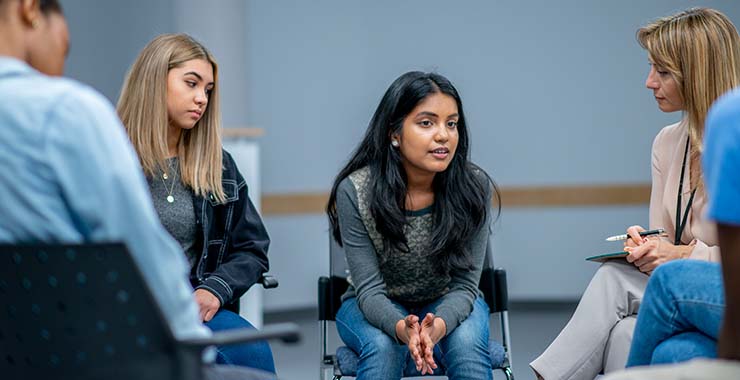
On April 18 and 19, 2023, APA and psychological science were front and center at a roundtable hosted by the National Governors Association chair, Governor Phil Murphy (D-New Jersey), in Detroit that focused on strengthening youth mental health. The meeting was the third roundtable hosted by Murphy and Governor Spencer Cox (R-Utah) this year to gather best practices and solutions to address the youth mental health crisis across the nation. Practitioners, academics, think tank researchers, insurers, philanthropists, and others gathered at the event to discuss improving maternal and infant health, strategies to improve access to quality care, mental health workforce solutions in the short and long term, and strategies to align state systems to innovate care and treatment.
APA was well represented at the roundtable by APA’s chief advocacy officer, Katherine B. McGuire, and on the workforce panel of experts that touched on topics of collaboration across siloed health systems, examining licensure requirements with the goal of protecting the public and speeding up processes, strategies to prevent provider burnout, and opportunities to incentivize and grow a more diverse behavioral health workforce.
Charmain Jackman, PhD, founder and CEO of InnoPsych, spoke about the importance of culturally relevant and representative care in schools, and the challenges with recruiting and retaining providers of color. She spoke about the need for a mental health literacy curriculum in K-12 schools and the need to expand and diversify the workforce to include peer support, community health workers, schools, and families in the mental health ecosystem of care. Jackman also emphasized the need to address the impact of racial stress on mental health outcomes for youth and their families.
“As we work to address the youth mental health crisis, we must take a multipronged approach that includes diversifying the workforce, using peer educator models for youth and their families, educating adults who interact with youth (e.g., coaches, teachers, summer employers), training of psychologists in liberation psychology practices, demystifying the therapy process in our communities, and advocating for inclusive mental health policies at the state and national levels,” Jackman said.

From left to right: Dave Anderson, PhD; Charmain Jackman, PhD; Tami Benton, MD; Governor Phil Murphy; William Hazel, MD; and Brittany Barber Garcia, PhD, ABPP
Brittany Barber Garcia, PhD, ABPP, chief of pediatric psychology at Helen DeVos Children’s Hospital in Grand Rapids, Michigan, discussed a wide range of challenges she sees in her daily work, including onerous credentialing for master’s level psychologists, the positive outcomes of the primary care behavioral health model for pediatric care, and the need for psychologists to practice to the full extent of their licensure both in person and via telehealth. She challenged changemakers to consider creative solutions to the current mental health workforce shortage and called out the burdensome education requirements and cost of unnecessary supervision requirements that negatively impact access.
Reflecting on her time at the roundtable, Barber Garcia said, “It was invigorating to see the lawmakers, insurers, mental health providers, and concerned community advocates come together to conceptualize solutions to these complex workforce challenges. My key takeaway from participating in the event is that change is not only possible, but by taking a multipronged approach considering education, licensure, telehealth access, and expansion of existing programming, we can realize improved mental health access for youth right now, when they need it most.”
The panel also included Tami Benton, MD, chief of psychiatry at Children’s Hospital of Philadelphia and president of the American Academy of Child and Adolescent Psychiatry, who extolled the value of telehealth in addressing health equity. Many participants raised the issue of burdensome state credentialing requirements for behavioral health providers, noting that it can take months for a provider to get credentialed after moving to a different state. Benton also pointed out the impact the behavioral health workforce shortage is having on team approaches to care.
Several speakers pointed to the Psychology Interjurisdictional Compact (PSYPACT) as the gold standard for the interjurisdictional practice of psychology. PSYPACT is designed to facilitate the practice of psychology both through telehealth and in-person visits across state lines. Murphy and Governor Gretchen Whitmer (D-Michigan) applauded their states for passing legislation to join the compact.
William Hazel, MD, senior executive director of the Claude Moore Foundation, also spoke about the siloing of programs and funding at the state and local levels and pushed for greater flexibility and engagement to break down bureaucratic barriers. APA member Dave Anderson, PhD, vice president of school and community programs at the Child Mind Institute, moderated the workforce panel discussion. His deep knowledge of health systems and population health approaches, as well as the licensure and education funding challenges, focused everyone’s attention on the role of psychologists in addressing the youth mental health crisis. According to Anderson, “It’s difficult to encapsulate the immense potential of such a vibrant discussion involving so many key stakeholders. Reflecting the leadership of Governors Murphy, Cox, and Whitmer, these meetings catalyze national investment in best practices in increasing the volume and diversity of the mental health workforce while also highlighting obstacles to care access and licensure portability.”
Participation in the roundtable follows recent advocacy by APA Services to strengthen the psychology workforce, call for maternal and child health program funding, and address the youth mental health crisis.
For more information contact Katherine B. McGuire.