


skip to main content

How to report smoking and tobacco use cessation counseling visits

APA Style leaf logo Cite This Article in APA Style
American Psychological Association. (2022, September 9). How to report smoking and tobacco use cessation counseling visits. https://www.apaservices.org/practice/reimbursement/health-codes/smoking-tobacco-cessation-counseling

The National Correct Coding Initiative (NCCI) is a program developed by the Centers for Medicare and Medicaid Services (CMS) to promote correct coding methodologies and to control improper coding that leads to inappropriate payment of claims. Recent advocacy efforts by APA Services resulted in changes in NCCI edits which now allow psychologists to report smoking and tobacco use cessation counseling services (CPT® codes 99406 or 99407) when performed at the same encounter as an individual psychotherapy session (codes 90832, 90834, and 90837). An appropriate NCCI Modifier must be appended.

Smoking is the leading preventable cause of premature death, resulting in about 480,000 deaths annually from diseases such as cardiovascular disease, respiratory disease, and cancer.i By providing these services, you can help your patients move towards a life free from the destructive impact of commercial tobacco*, which can reduce their risk of many potentially fatal diseases and put them on track for a healthier lifestyle.
Why are smoking and tobacco use cessation counseling services important?

Patients diagnosed with mental and behavioral health disorders have higher rates of smoking as well as increased morbidity. In 2016, 34.6% of adults with any mental illness reported current use of tobacco compared to 23.3% of adults with no mental illness.ii Nearly 25% of adults in the United States have a mental health or substance use disorder (i.e., behavioral health condition), and these adults consume almost 40 percent of all cigarettes smoked by adults in the United States.iii

The most common causes of death among people with behavioral health conditions are heart disease, cancer, and lung disease, which can all be caused by smoking. People with behavioral health conditions who smoke cigarettes are four times more likely to die prematurely than those who do not smoke. Additionally, these individuals account for nearly half of all tobacco-related deaths each year.iv Smoking can exacerbate mental health symptoms and complicate treatment.v,vi,vii

Quitting smoking can improve mental health and substance use disorder recovery outcomes.iii,iv,v,vi,viii,ix Tobacco smoke can interact with and inhibit the effectiveness of certain medications taken by patients with behavioral health conditions, often resulting in the need for higher medication doses to achieve the same therapeutic benefit.iv Although often not the primary presenting problem for which patients seek out psychological assistance, the disproportionate rates of smoking among individuals living with mental health difficulties uniquely poises psychologists to effectively reach more individuals with this life-saving intervention.

ADVERTISEMENT

Components of smoking and tobacco use cessation counseling services

Medicare Part B covers two levels of tobacco cessation counseling for beneficiaries: intermediate and intensive. Intermediate sessions (code 99406) represent counseling the patient for 3–10 minutes, while intensive sessions (code 99407) describe counseling the patient for greater than 10 minutes.

For counseling to qualify for Medicare payment, the following criteria must be met at the time of service: 

  • The patient uses tobacco, regardless of whether they have signs or symptoms of tobacco-related disease.
  • The patient must be competent and alert at the time that counseling is provided.
  • Counseling is furnished by a qualified physician or other Medicare-recognized practitioner.

Performing smoking and tobacco use cessation counseling services, involves:

  • Assessing the patient’s readiness for change.
  • Addressing barriers to change and ways to avoid relapse.
  • Advising the patient to make changes in their behavior.
  • Providing specific suggested methods and interventions and helping to motivate the patient to quit using commercial tobacco products to improve their overall health and well-being.
  • Offering additional resources, such as support groups for relapse prevention, or state tobacco cessation quitlines for support often including nicotine replacement therapy (NRT; patches, gum, lozenges, etc).

The following are recommendationsopens in new window, published by the U.S. Preventive Services Task Force (USPSTF), that provide guidance regarding interventions that can be used to engage patients in conversation regarding cessation of commercial tobacco products:

  1. Ask all adults, including pregnant persons, about tobacco use, using methods such as: 
  • “5 A’s”: Ask, Advise, Assess, Assist, Arrange follow-up
  • “Ask, Advise, Refer”
  • “Vital Sign”: Treat smoking status as a vital sign—which means assess regularly
  1. Provide cessation interventions to persons who use commercial tobacco:
  • For nonpregnant adults, provide behavioral counseling for cessation:
  • Effective behavioral counseling interventions include provider advice, individual counseling, group behavioral interventions, telephone counseling, and mobile phone–based interventions.
  • Combined behavioral counseling includes at least four or more behavioral counseling sessions with 90 to 300 minutes of total contact time.
  • For pregnant persons, provide behavioral counseling for cessation:
  • Effective behavioral counseling includes cognitive behavioral, motivational, and supportive therapies such as counseling, health education, feedback, financial incentives, and social support.

Additionally, the Centers for Disease Control and Prevention (CDC) offers numerous patient care resourcesopens in new window to help clinicians have conversations with their patients about smoking and commercial tobacco use cessation.

How do Tobacco Cessation services connect to APA initiatives?

APA is dedicated to improving population health, along with advocating for financial incentives that support psychologists’ involvement in these efforts. A population health approach, or preventive health approach, focuses on improving the health, health equity, safety, and well-being of entire populations, including individuals within those populations. 

Integrating smoking and tobacco use cessation counseling services into routine practice is one way that psychologists can address population health and be reimbursed for those services.

Clinical examples

Background

A patient requests an initial appointment for assistance with depressive symptoms and interpersonal difficulties. While assessing the patient’s health history, they report using commercial tobacco, smoking 10–15 cigarettes each day. They aren’t opposed to talking about their smoking but really want to focus first on a plan to address their presenting problems. An initial treatment plan is agreed upon, and the first psychotherapy session is scheduled for later that week.

Scenario 1 for code 99406 (3-10-minute intervention)

As the first session hits the 54-minute mark, the patient offhandedly mentions “they really need a smoke.” You ask if they’d be open to discussing their smoking in session, and they seem hesitant but agree. You thank them for their openness and explore their smoking habits, understanding of health risks to themselves and others around them, and assess their readiness to quit. You let them know that as the number one cause of preventable death in the country, you recommend to all your patients who smoke that they consider quitting. Your patient thanks you for your recommendation and says they’ll think about it, but they aren’t ready to quit yet. They ask you to check in about it again in a month or two. You provide them with a brochure for your state’s tobacco quitline and let them know they can call anytime for support. The total session lasted 60 minutes with 54 spent addressing the patient’s depressive symptoms and six focused on smoking cessation.

  • Report CPT® code 90837 for the 60-minute psychotherapy session and 99406, and append the -59 modifier, indicating that 3-10 minutes of smoking and tobacco use cessation counseling was performed as an independent service.

Scenario 2 for code 99407 (10+ minute intervention)

As the first session nears the 45 minute mark, the patient again shares that they often “step outside for a smoke” after arguments at home, and that it leaves them “more depressed after the buzz wears off.” You ask if they would be open to using some session time to explore their smoking and they agree. At the 43-minute mark, you spend five minutes assessing their smoking habits, understanding of health risks, and readiness to quit. Then, for seven additional minutes you use an ACT-informed approach to support the patient with their expressed desire to quit. You provide your patient the information for their state’s tobacco quitline and encourage them to call as needed for cessation support between sessions. You continue to use the last 12–15 minutes of the next three sessions focusing on tobacco cessation counseling. Your patient then transitions to tobacco quitline support and tells you they are no longer smoking at their regular session 12 weeks later. The total session lasted 55 minutes with 43 minutes spent on the patient’s depressive symptoms and 12 minutes spent on tobacco cessation.

  • Report CPT® code 90834 for the 45-minute psychotherapy session and 99407, and append the -59 modifier, indicating that greater than 10 minutes of smoking and tobacco use cessation counseling was performed as an independent service.

Billing, coding and documentation guidance

As mentioned previously, Medicare Part B covers two levels of tobacco cessation counseling for beneficiaries: intermediate (99406) and intensive (99407). The level of service reported is dependent upon the amount of time spent performing smoking and tobacco use cessation counseling services.

When performed in conjunction with 30, 45, or 60 minutes of psychotherapy, it is strongly recommended that you track and document in the patient’s record the total face-to-face time with the patient, as well as the precise start and stop times spent specifically performing smoking and tobacco use cessation counseling. Documenting in this manner will show that while the two services were performed during the same encounter, the tobacco cessation counseling was considered a distinct and separately identifiable service.

In addition to the amount of time spent counseling the patient, other elements to be documented to support medical necessity of the service include: 

  • Verification of the patient’s history of tobacco use.
  • Assessed willingness to attempt to quit. Was a quit date set?
  • Details of what was discussed during counseling, such as cessation techniques and resources.
  • Any follow-up planned and/or arranged.
CPT® Code Descriptor 2022 wRVU 2022 Medicare Non-Facility Payment 2022 Medicare Facility Payment
Smoking and Tobacco Use Cessation Counseling Visits
99406 Smoking and tobacco use cessation counseling visit; intermediate, greater than 3 minutes up to 10 minutes 0.24 $15.57 $12.11
99407 Smoking and tobacco use cessation counseling visit; intensive, greater than 10 minutes 0.50 $28.72 $25.61
  • Do not report 99406 in conjunction with 99407.
  • Do not report 99406 for less than three minutes of service.
  • When performed on the same date of service as a psychotherapy session, Modifier 59 will be needed to indicate that Smoking and Tobacco Use Cessation Counseling was an independently performed service.

Please note: CPT code 99407 is not an add-on code. Only one of the codes should be reported on a claim form, depending on the amount of time that was spent performing the counseling visit.

Medicare will cover two (2) cessation attempts per year. Each attempt may include a maximum of four (4) intermediate or (4) intensive sessions, with the total annual benefit covering up to eight sessions in a 12-month period.

While the practitioner and patient have flexibility to choose between intermediate or intensive cessation strategies for each attempt, it is very important to be aware that frequency limits are beneficiary-specific; therefore, prior to providing tobacco cessation counseling to a beneficiary, you should review a given beneficiary’s previous service provision (i.e. number of counseling attempts the patient has received from other providers) within the preceding 12-month period to ensure claims are not denied due to exceeding the individual patient frequency limit. APA Services also recommends that checking each commercial payer policy, and the list of codes included in your contract with each payer, to determine coverage for this service.

APA Services is aware of commercial payers that will reimburse psychologists for reporting codes 99406 or 99407, as well as some Medicaid programs.  To reduce the risk of your claim(s) being denied for reporting noncovered/noncontracted codes, APA Services recommends that you check each commercial payer policy, as well as the list of codes included in your contract with each payer, to determine which codes are covered/reimbursed.

How to report tobacco cessation counseling services on your claim form

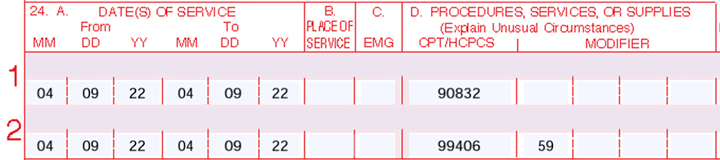
When tobacco cessation counseling services are performed at the same encounter as a psychotherapy session (codes 90832, 90834, 90837), both services should be listed on the billing form along with modifier -59 appended to the appropriate tobacco cessation code, which indicates that the tobacco cessation counseling service was distinctly and independently from the psychotherapy service.

This illustration, using the CMS-1500 form, shows how to report an intermediate smoking and tobacco use cessation counseling visit (code 99406) performed during the same encounter as a 30-minute psychotherapy session (code 90832).

CMS-1500 form showing how to report an intermediate smoking and tobacco use cessation counseling visit (code 99406) performed during the same encounter as a 30-minute psychotherapy session (code 90832)

References

i Centers for Disease Control and Prevention. Health Effects of Cigarette Smoking Fast Facts and Fact Sheets. Smoking and Death. 2017.

ii Substance Abuse and Mental Health Services Administration. Results from the 2016 National Survey on Drug Use and Health: Detailed Tables.pdf. Rockville, MD: Substance Abuse and Mental Health Services Administration, Center for Behavioral Health Statistics and Quality, 2017.

iii Center for Behavioral Health Statistics and Quality. The NSDUH Report: Adults With Mental Illness or Substance Use Disorder Account for 40 Percent of All Cigarettes Smoked [PDF–563 KB]. Rockville, MD: Substance Abuse and Mental Health Services Administration; 2013.

iv Smoking Cessation Leadership Center. Fact Sheet: The Tobacco Epidemic Among People With Behavioral Health Disorders. San Francisco: Smoking Cessation Leadership Center, University of California, 2015.

v Lipari R, Van Horn S. Smoking and Mental Illness Among Adults in the United States. The CBHSQ Report: March 30, 2017. Rockville, MD: Center for Behavioral Health Statistics and Quality, Substance Abuse and Mental Health Services Administration.

vi Centers for Disease Control and Prevention. Vital Signs: Current Cigarette Smoking Among Adults Aged ≥18 Years With Mental Illness—United States, 2009–2011. Morbidity and Mortality Weekly Report 2013;62(05):81-7.

vii NIH State-of-the-Science Panel. National Institutes of Health State-of-the-Science conference statement: tobacco use: prevention, cessation, and control. Ann Intern Med. 2006;145:839‐844

viii NIH State-of-the-Science Panel. National Institutes of Health State-of-the-Science conference statement: tobacco use: prevention, cessation, and control. Ann Intern Med. 2006;145:839‐844

ix Centers for Disease Control and Prevention. Vital Signs Fact Sheet: Adult Smoking Focusing on People With Mental Illness, February 2013. National Center for Chronic Disease and Health Promotion, Office on Smoking and Health, 2013.